Upload your cargo list, pick a vessel and get back multiple loading arrangements, each with ballasting, stability, structural strength, grain stability and draft checks already done. Your port captain reviews pre verified options instead of building every plan from scratch.
The Problem
A cargo nomination arrives. Operations drafts a loading plan. It goes to the technical team for stability and strength checks. Revisions follow. For multi cargo voyages, this cycle repeats for every arrangement. The whole process can take hours or days.
Ballasting calculations, GM verification, shear force and bending moment checks these require operational experience. Your port captain knows how to do them, but they're juggling five vessels at once. Operations can't prepare even a draft plan without them, so everything queues up behind one person.
Is there a better cargo distribution? Would a different vessel work? What if you loaded the high density cargo in hold 3 instead of hold 5? Today, every alternative means restarting the calculation from scratch.
Before committing to a vessel, a charterer has no fast way to confirm whether the cargo actually fits within all stability, strength and draft limits. They rely on the owner's word or pay for a manual study.
Stowage Planner Bulk is the first tool that automates the full cargo to hold assignment and ballasting workflow in a single pass including stability, structural strength, grain stability, tanktop loading and draft verification. Upload a cargo list, select a vessel, set your constraints and the system produces verified options for your technical team to review.
The same work that takes hours of manual iteration between planners and loading computers done in minutes.
How It Works
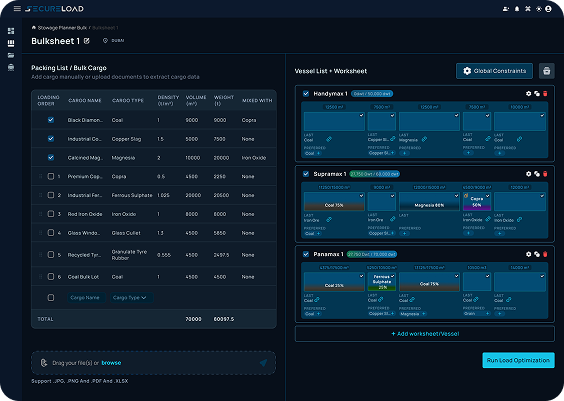
Drop a cargo list PDF, image, or spreadsheet. AI extracts the cargo details automatically. Or enter them manually.
Select any vessel from your fleet database. Set the constraints that matter: trim range, minimum GM, draft limits, air draft, number of arrangements to generate.
Optimization algorithms assign cargo to holds, compute ballasting for each arrangement and verify stability, structural strength and drafts. Plans that fail any check are filtered out.
Compare the verified arrangements side by side. Approve the best one and push it directly to the vessel's onboard loading computer through Fleet Connect.
Real Scenarios
Under the Hood
The engine doesn't just fill holds sequentially. Integrated optimization algorithms evaluate weight distribution, hold capacity, port rotation, IMSBC cargo compatibility and segregation rules simultaneously producing the best possible cargo to hold assignments across as many arrangements as you request.
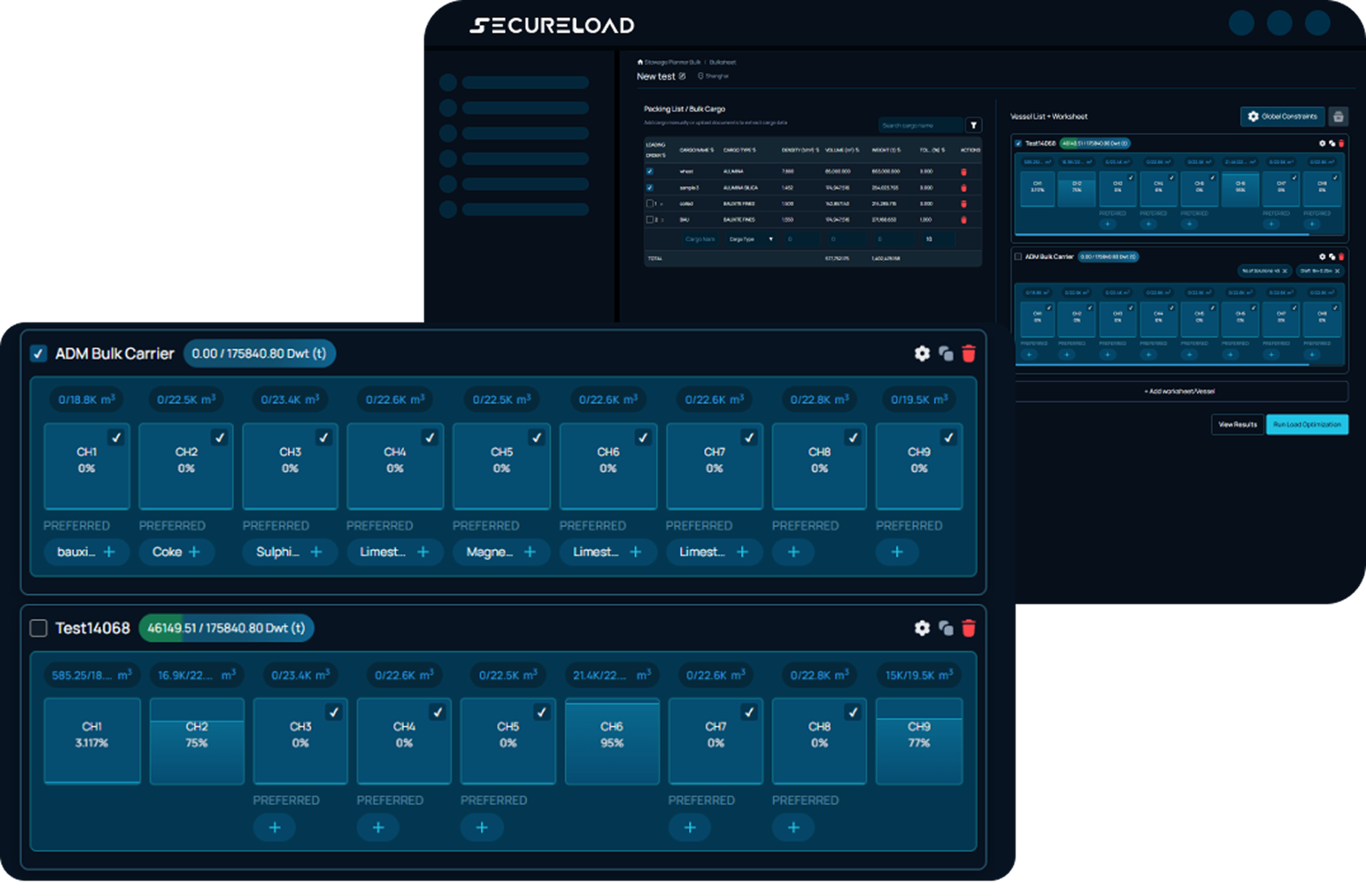
For each cargo arrangement, the engine's optimization algorithms determine the best ballast tank configuration — iterating through combinations to find the distribution that satisfies stability (GM after free surface correction, trim, heel), structural strength (shear force, bending moment) and draft limits simultaneously. Arrangements that fail any check never reach your screen. This eliminates the manual iteration between cargo planners and loading computer operators.
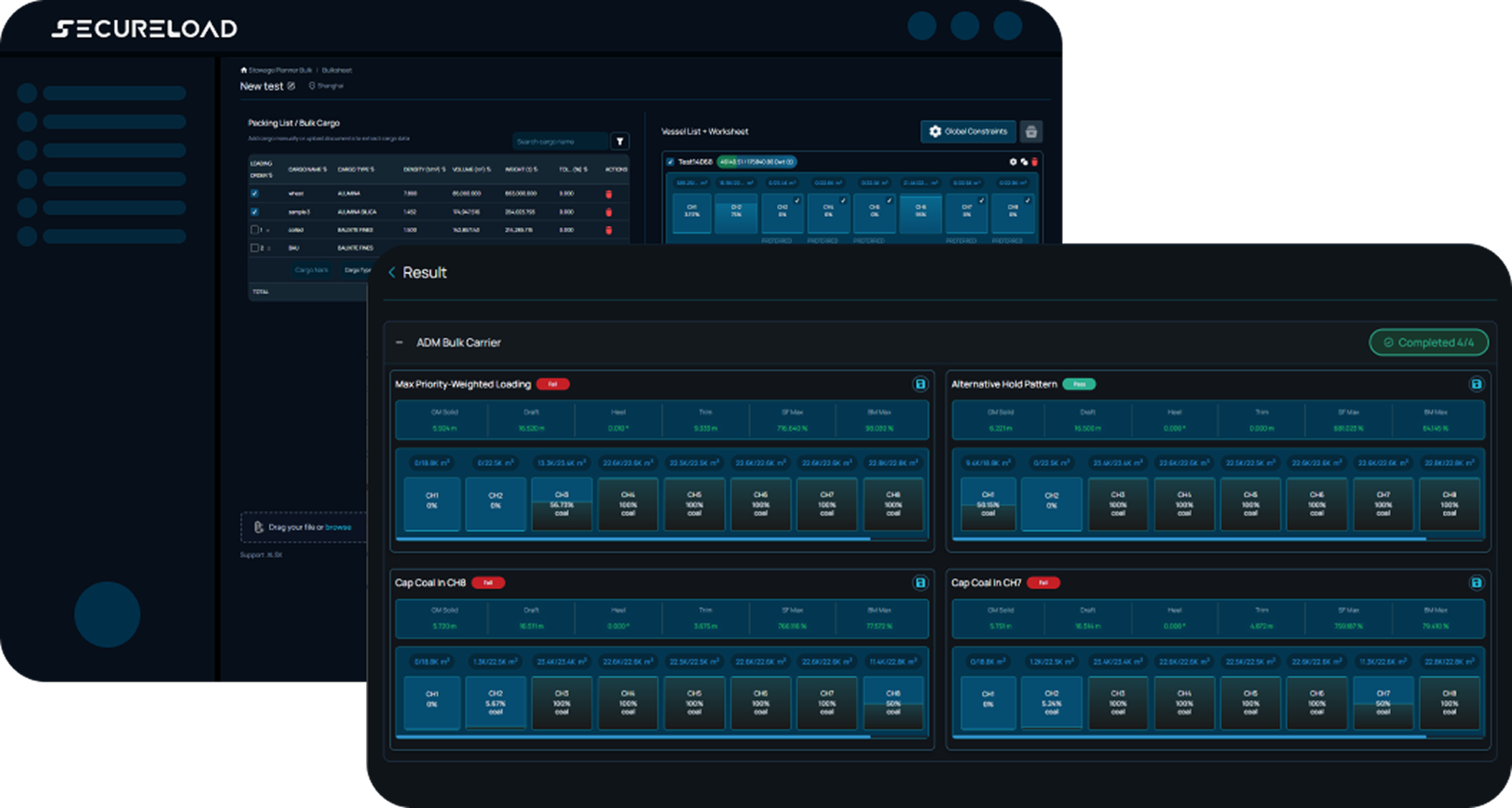
The IMSBC Code actively governs cargo assignment not just as a reference, but as a constraint the optimization engine enforces in real-time. Incompatible cargoes are never assigned to adjacent holds. The system also computes whether hold washing is required between consecutive cargoes, giving your operations team visibility into turnaround needs before the vessel arrives at port.
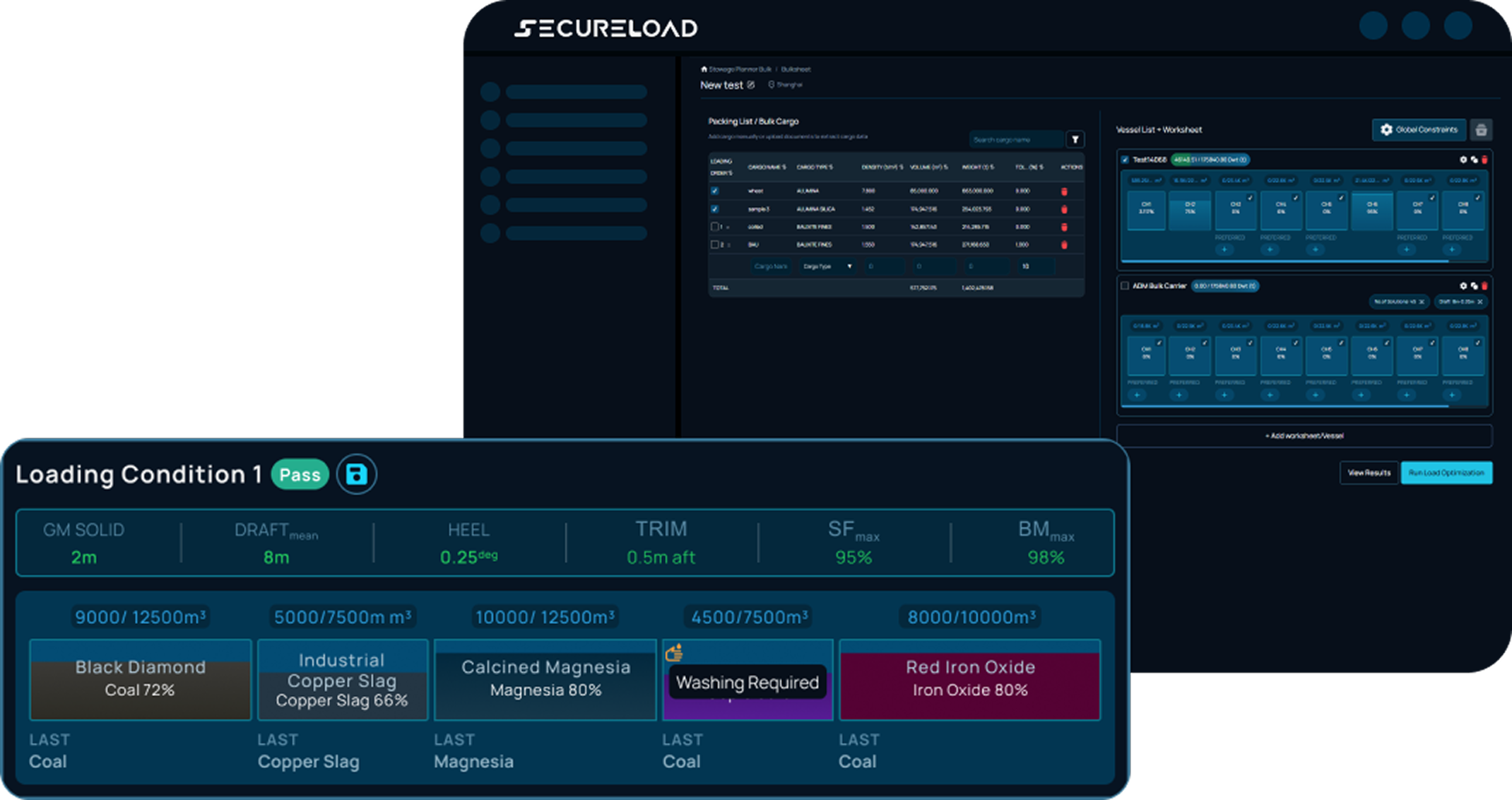
Every plan is checked

The optimization engine decides which cargo goes into which hold factoring in weight limits, stowage factors and port rotation. You get multiple arrangements to choose from, not just one.

For every cargo arrangement, the engine computes the optimal ballast tank configuration accounting for free surface effect at every step so stability, trim, and structural strength all pass without manual trial and error.

Every plan is checked against GM (with free surface correction), trim and heel limits both regulatory and any limits you set yourself. Solid GM and fluid GM are computed separately so your technical team sees the full picture.

Shear force and bending moment are evaluated along the full length of the vessel. If any structural limit would be exceeded, that arrangement is flagged or filtered out.

Forward and aft drafts are checked against port and channel limits. Air draft clearance is verified too so you know the vessel will clear bridges and terminal restrictions.

Incompatible cargoes are never placed in adjacent holds. The system also tells you whether hold washing is needed between consecutive cargoes so your operations team can plan turnaround before the vessel arrives.

For high density cargoes like iron ore and manganese, the tanktop loading limit (t/m²) is often the binding constraint not volume or deadweight. The engine checks tanktop pressure for every hold assignment.

For grain cargoes, the engine performs full IMO Grain Code compliance checks volumetric heeling moment (VHM) calculations, grain shift angle verification and residual dynamic stability area, for both filled and partly filled compartments.

Slack ballast tanks reduce effective GM. The engine computes free surface corrections at every loading condition, showing both solid and fluid GM so your technical team sees exactly how stability margins are affected during ballast operations.

Generate pre verified loading options from the office and send them to your port captain for final review. Every arrangement is checked for stability, strength, tanktop loading and draft reducing turnaround from hours to minutes.

Before you commit to a fixture, confirm the cargo actually fits. Run the planner against any nominated vessel and see whether all limits are met in minutes, not after a manual study.

Upload a cargo list, set your constraints and get back verified stowage options ready for technical sign off. Operations staff can prepare loading plans that arrive on the port captain's desk already checked against stability, strength and regulatory limits.

Review every arrangement with full visibility into stability, strength and ballast conditions. Approve the best plan and push it directly to the vessel through Fleet Connect.